

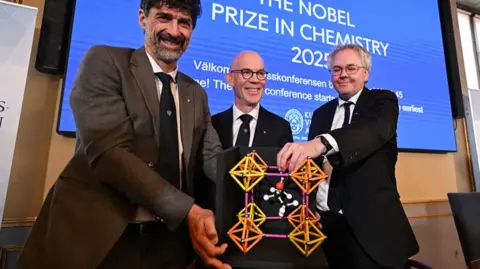
This year's prestigious award in the field of chemistry is given to three distinguished scientists for their influential work on MOFs.
The scientists' investigations has potential to tackle some of the pressing planetary challenges, for instance CO2 capture to address global warming or curbing plastic pollution through innovative scientific methods.
“I feel tremendously honored and overjoyed, many thanks,” said Prof. Kitagawa during a call with the press briefing following learning the announcement.
“How long do I have to stay here? Because I have to go out for a meeting,” Professor Kitagawa added.
The three laureates receive monetary reward of 11 million Swedish kronor (£872,000).
Molecular Architecture on a Center of their Breakthrough
The researchers' research involves how molecules are built together into complex frameworks. The Nobel committee described it as “structural molecular engineering”.
The experts developed methods to create assemblies with large spaces among the components, allowing various substances to flow within them.
Such compounds are called MOFs.
The declaration was made by the academic institution at a press event in the Swedish capital.
Professor Kitagawa works at the University of Kyoto in Japan, Richard Robson is associated with the University of Melbourne in Australia, and Omar Yaghi is at the University of California in the USA.

Previous Award Recipients in Scientific Fields
During the prior award cycle, three other scientists won the honor for their studies on protein structures, which are fundamental elements of life.
It is the 3rd scientific award awarded in the current week. Previously, three physicists received the Physics Nobel for their contributions on quantum theory that paved the way for the advancement of the quantum computer.
At the start of the week, 3 scientists studies on how the biological immunity targets harmful microbes secured them the award for medicine.
One winner, Dr. Ramsdell, missed the notification for nearly a day because he was on an remote hiking trip.


